 |
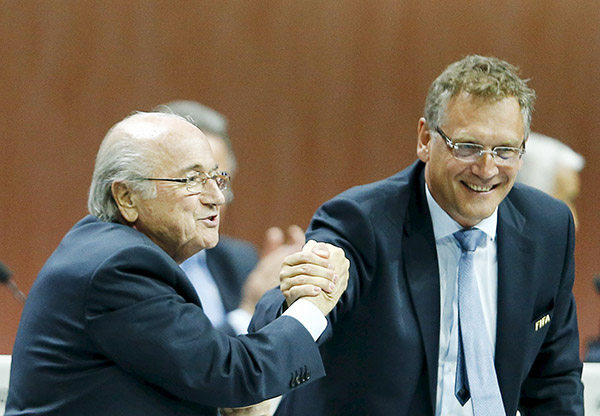
| FIFA President Sepp Blatter (L) and Jerome Valcke, Secretary General of the FIFA do a Handshake For Peace at the 65th FIFA Congress in Zurich, Switzerland, in this May 29, 2015 file photo. U.S. authorities believe FIFA President Sepp Blatter's top lieutenant made $10 million in bank transactions that are central to the bribery investigation of the world soccer body, the New York Times reported on Monday, citing unnamed law-enforcement officials. The newspaper said FIFA Secretary General Jerome Valcke is the unidentified "high-ranking FIFA official" who prosecutors say transferred the sum in 2008 to another FIFA official, Jack Warner. [Photo/Agencies] |
GENEVA, June 8 -- As U.S. investigations probe deeper into FIFA, it is important to understand how U.S. authorities instigated arrests in Zurich in the past two weeks, where nine FIFA officials and five corporate executives were indicted on allegations of fraud, bribery and money laundering.
In an interview with Xinhua, University of Geneva Law Prof. Margareta Baddeley pointed out: "U.S. anti-corruption law enables authorities to investigate individuals suspected of private corruption even in affairs which are conducted in foreign countries, if a link with the United Statesexists."
To her knowledge, "the alleged corruption charges affecting FIFA officials would fall under this law as certain payments were made via American banks, amongst others."
According to officials, U.S. legislation can target foreigners if they are in violation of certain laws if a proven link with the country can be established -- this can include wire transfers, emails and phone calls which took place in the United States.
These kinds of cases also take time and a great deal of cooperation given the international scope and the complexity of the charges.
According to Baddeley, the investigations carried out by the U.S. justice system were instigated a few years back, after which a mutual legal assistance request was sent by U.S. authorities to Switzerland.
"Once this was accepted by a Swiss judge, this lead to the arrests conducted by Swiss police," Baddeley explained, adding that "the Swiss justice system, under certain conditions, could subsequently agree to extradite those arrested."
For this to happen, it must be proven that the corruption charges brought against those incriminated are also punishable under Swiss law, "a point U.S. and Swiss authorities are probably trying to verify at the moment," said Baddeley.
Though there has been cooperation between both countries, Baddeley said Swiss corruption laws are not as stringent as in the United States.
"Swiss law prohibits both civil servants (this is not the case of FIFA officials) and private corruption under two conditions: if the corruption is linked to unfair competition and if a complaint is lodged."
The law professor added that these two conditions are difficult to establish in corruption cases relating to sport as this sector's market is often monopolistic by nature, and individuals or entities who could lodge a complaint are often intrinsically linked to fraudulent activities themselves.
She added investigations can be rendered more complicated as fraudulent payments such as bribes often circulate via different financial intermediaries and international front companies.
According to Switzerland's Federal Office of Justice (FOJ), six out of the seven arrested late last month have contested their extradition to the United States, giving U.S. authorities 40 days to submit a formal extradition request.
 In pictures: School life of students in a military college
 J-11 fighters in air exercise
 Hefei-Fuzhou railway line put into trial operation
 PLA soldiers operate antiaircraft guns in drill
 Charming robot teacher gives lecture in Jiangxi
 PLA soldiers conduct 10-kilometer long range raid
 Graduation season of a costume designing major
 Beauties dancing on the rings
 Villagers pick cubiloses on cliff in Sichuan
 Manila overvalues new pact with Tokyo
 The mysterious ‘people of Chaoyang district’
 NDRC mulls new guidelines for auto sector
 Opportunists in Hong Kong target traders to exploit resentment of mainland
Day|Week