China Daily News
Dongba scripture
preserved
By Zong He
KUNMING _ Three years of hard
work is finally paying off. And Zhao Shihong, deputy director of Dongba Culture Research
Institute, couldn't be happier.
The first 50-volume set
of "The Completed Translated Works of Dongba Scriptures," with 45 million words,
will be published in October.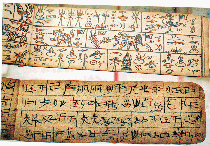
Dongba scriptures are
believed to be as old as the inscriptions on bones and tortoise shells from the Shang
Dynasty (16th century - 11th century BC).
They were created to
record the tribe's history, mythology, religion and social customs by ancient dongbas, the
religious leaders of Naxi people living around Lijiang County in northwestern Yunnan
Province.
These types of
characters are now virtually extinct. Influenced by the Han people, Naxi people began
learning the Chinese language and its characters.
Also, Naxi's religious
activities were regarded as superstitious and were forbidden in the 1950s. Subsequently,
few young Naxi people turned to the dongbas to study the scriptures and religious rituals.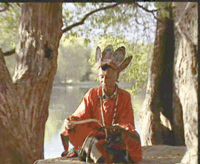
Only a few dongbas who
wrote and used the unique characters are still alive. That makes the scriptures all the
more precious, said Zhao.
Since the institute was
established in 1981, Zhao and his staff have preserved such cultural relics, and made the
abstract language more understandable to the world.
Chinese experts began
collecting copies of these scriptures in the 1950s. Foreigners had been collecting them
since the 1920s.
More than 25,000 copies
of such scriptures, in 1,000 categories, have been discovered. Half of these, however, are
believed to have been taken abroad by botanist Joseph Rock.
The scriptures he sent
back with his plant specimens were preserved in libraries and museums in the United
States, Britain and other European countries.
Some Chinese libraries
and museums _ including Beijing, Nanjing and Kunming _ have several of these original
documents.
Lijiang has 6,500 copies
of Dongba scriptures, recording the Naxi culture over a 1,000-year period.
The institute, in
addition to collecting as many copies as possible, began translating the scriptures three
years ago.
But the 12 researchers
encountered difficulties. Two dongbas _ He Kaixiang, 76, and He Jigui, 73, _ were invited
by the institute to help translate the scriptures.
The work was tough.
Although only 1,400
symbols were used, each had numerous sounds and meanings.
"Each symbol
usually has several pronunciations according to context, and every pronunciation has a
distinct meaning," Zhao explained.
The character's
abbreviated forms posed additional challenges.
Since the scriptures
were written and handed down by many dongbas throughout the generations, they changed
gradually during the centuries.
For example, if one
dongba shortened a five-symbol sentence to a two-symbol one, his followers did the same.
But the changes were not always understood by others.
The publishing house,
because the contents presented by the institute were difficult to understand, did not
proofread or edit the materials.
Each volume of the opus
is composed of four parts: 10 or more Dongba scriptures; each symbol's pronunciation
marked in the international phonetic alphabet; literal translation of each symbol; and a
translation of each sentence or paragraph.
An additional 50 volumes
will be published next year, Zhao said.
The institute will work
on other projects to preserve the Dongba culture, releasing tapes of Dongba chants and
video tapes and CDs featuring Dongba religious rituals.
The institute, Zhao
said, will thoroughly research materials collected and translated about Dongba culture.
A Dongba Art Festival
will be held in Lijiang _ featuring workshops, art shows and Naxi traditional cultural
activities _ in October.
"We must try
to do something as soon as possible because the remaining living dongbas are very
old," Zhao said.
"No other people
could ever understand the scriptures and culture as the priests do," he added.
(Photo: above: Hieroglyphics on a
Dongba manuscript.
next to above: He Kaixiang
practises dongba singing.)