Watery memories from Erhai
By Luo Jie
 THERE may be quicker ways to cover the 15 kilometres
between the tourist haven of Dali and Yunnan Province's second-largest city, Xiaguan, but
none is quite so breathtaking and picturesque (and sometimes fraught with danger) as a
trip by a small converted fishing boat on Erhai Lake.
THERE may be quicker ways to cover the 15 kilometres
between the tourist haven of Dali and Yunnan Province's second-largest city, Xiaguan, but
none is quite so breathtaking and picturesque (and sometimes fraught with danger) as a
trip by a small converted fishing boat on Erhai Lake.
The lake, so named because of its
vague resemblance to the human ear, is 41 kilometres long and 3 to 9 kilometres wide. It
lies in a geological fault between mountain ranges in northwestern Yunnan on the way from
Kunming to Lijiang and is part of the Mekong River system.
As you cross the last
mountain pass on the way south from Lijiang, you can see Erhai Lake glimmering and
shimmering in the distance, a blanket of blue between the steep green slopes of the
Cangshan and Hongshi mountains.
Once you reach the flat
plain bordering the lake on its western shore, you find yourself in the midst of a vast
expanse of paddy fields stretching from the lake shore to the foot of the Cangshan
Mountains.
Every inch of this
fertile ground is put to use, with human habitation being generally restricted to the lake
shore or the foot of the mountains.
The rice harvest is abundant in
summer and autumn and the fields are full of farmers, many in Bai minority dress, toiling
away at their backbreaking task. Rice is an unforgiving crop.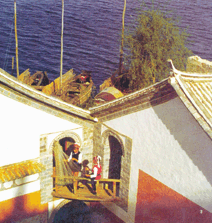
Dali is a compact little
town, a peaceful backwater now bypassed by the new highway. This makes it an ideal place
for a few days of relaxation after a hectic tour of other parts of Yunnan.
Xiaguan, on the other
hand, is an ugly commercial sprawl, but as it is an obligatory passage for all buses to
the west and northwest of the province, it is unavoidable.
So, why not make the
trip there as memorable as possible?
There is no shortage of
opportunities to negotiate a boat trip. Just stand in the middle of the main street of
Dali's old town and in no time at all you will be approached by an elderly woman, her face
burnished by the sun and the wind, her eyes glinting at the prospect of persuading you
that her son's boat, which just happens to be the most luxurious and well-equipped on the
lake, is now moored at the shore ready to cast off waiting for one last passenger to make
up its contingent.
After an esoteric
discussion on the real meaning of luxury and more practical negotiations on the price
required for the journey, a deal is struck.
The old woman grabs your
bags and heads off for the North Gate at a pace that leaves the unsuspecting tourist, more
used to the stately saunter generally practised when visiting scenic spots, gasping for
breath several paces behind.
Dali town lies 3 or 4
kilometres from the lakeside and the boat trip comes complete with a horse-drawn carriage
ride from town to shore. Unfortunately, these carriages are not allowed inside the wall of
the old town, so a lengthy hike is required.
Disappointingly, the
horse-drawn carriage has metamorphosed into a horseless one, but it's too late to turn
back, so you clamber on board and, breathing in the sweet smell of diesel fumes, head off
down a potholed track to the lake.
The vehicle screeches to
a halt at the entrance to a village on the lake shore, and you trudge through the narrow
streets towards the lake glinting ever nearer.
The luxury liner turns
out to be a small converted fishing boat with a few chairs and an awning for protection
from the sun, so all your fears about the trip being laid on solely for feather-bedded
tourists are immediately banished from your mind.
With your money safely
in the captain's pocket, you are invited aboard. The sole means of access is a solitary
plank of wood about 3 metres long and 10 centimetres wide placed at an angle of 45 degrees
to the bank. Not being of a particularly acrobatic disposition, you are momentarily
puzzled how to perform the feat of walking this particular plank. Your luggage is thrown
on board, you close your eyes and jump from the bank onto the plank and then into the boat
as though you had been doing it all your life.
Once safely seated in
the prow, the trip begins, with the waters inshore as calm as a millpond. As you chug
slowly out towards the middle of the lake, the view of the Cangshan Mountains to the west
is a thrilling sight. The undulating skyline of 19 peaks about 4,000 metres high, some
framed by clouds, others standing starkly against the blue sky, leaves you in awe at the
majesty of nature.
At the foot of the
mountains, the plain, green with the sprouting rice, stretches languorously down to the
lake. The Yellow River may be China's sorrow, but Erhai Lake has been Dali's sorrow many
times in the past as heavy rains have caused many devastating floods.
But there is no sign of
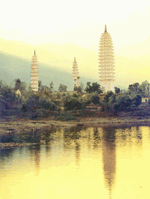
this now as Dali's trademark attraction, the Three Pagodas, stands proudly in the
distance, remaining clearly visible as the boat pursues its journey.
The east side of the
lake provides a strongly contrasting picture. The barren Hongshi (Red Rock) Mountains rise
sheerly out of the water, with a few villages or temples clinging to their rocky
promontories.
As the boat approaches
the centre of the lake and Luoguan Temple appears at the crowning point of an arid
peninsula opposite Dali, the wind suddenly gets up. The locals are used to the changing
direction of the lake breezes. The stiff northerly winds of the early morning veer round
during the day to blow from the south in the afternoon.
This means that as the
boat heads east, it is buffeted by ever-higher waves and a swell that causes the vessel to
toss alarmingly from side to side. The manes of the white horses on the crests of the
waves get thicker and thicker and the boat's progress slows to a crawl.
Someone on the boat
tries to stand up, but is immediately thrown to the deck as the vessel pitches from port
to starboard. The only option is to grit your teeth and hang on to the side, safe in the
knowledge that there is no way the captain is going to risk losing his livelihood by
having his pride and joy capsize.
Gradually the boat
inches forward as the breeze stiffens. You pass fishermen standing up in their boats
hauling in their nets and you marvel at their sense of balance. You cast an anxious glance
back west and see the Cangshan Mountains still there, massive and reassuring. Taking
advantage of a lull in the wind, you twist round to look east. You are now almost level
with Luoguan Temple and approaching Jinsuo (Golden Shuttle) Island, the promise of shelter
from the breeze.
The island was once the
summer retreat of the Nanzhao dynasty that ruled in Dali in the 8th to 10th centuries. Now
the island is only home to a small fishing community, a tiny open-air market and a
Buddhist temple. But it is still worth walking the plank again to explore the village and
try to identify the various fish and shellfish offered for sale in the market.
The boat sounds its
siren, so everybody goes back on board to complete the trip to Xiaguan. Coming out of the
lee of the island, the wind springs up again, but now the boat is heading south cleaving
its way through the waves, which it meets head-on.
As the sun sinks lower
in the sky, the mountains go into shadow, but the lake retains the brilliance of its blue,
offset by the white-flecked waves. Dali gradually shrinks in the distance and the concrete
towers of Xiaguan loom in front.
Lying in your hotel bed
that night, your skin tanned by the sun, the wind and the waves, the hooting of the
traffic is slowly replaced as you drift off into your dreams by the sound of waves lapping
against the boat. (China Daily Reports)
( Photo: top: The Three
Pagodas have become a landmark of Dali.
next to top: A fisherman's
houseon Erhai Lake. )