Hot spring resort gives relaxation
By Chen Liang
KUNMING _ While in this
"spring city," you have many choices to find a scenic attraction to spend the
weekends.
These include an
interesting hike in the Western Hills, a tour of teahouses along the Cuihu Park, enjoying
barbecue in the Kunming Botanic Garden, or to escape from urban clamours in one of the
Stone Forest hotels.
If you expect to find a
place to completely relax _ not only your nerves but also your muscles _ after one-week of
hard work, you can head for Anning.
With both the secluded
Caoxi Temple and the famous hot spring resort, Anning is one of the best destinations near
Kunming for a one-night repose.
About 50 kilometres
southwest of Kunming, the Temple and the Hot Spring Resort are located in the vicinity of
the Town of Anning. It took me less than two hours to get there from Kunming in the
afternoon of last Saturday.
The hot spring resort
lies in a wide valley embraced by two rolling green hills, through which runs a river
called "Tanglang" (mantis in Chinese). There are many hotels and guesthouses
lining along the well-paved sides of the Tanglang River.
Our first destination,
the Caoxi Temple, is hidden in the Cong Hill north of the river.
When we arrived at the
temple, situated in a bamboo grove, at 4:00 pm, most of tourists have already left,
leaving the place empty.
However, as a
large-scale renovation project was underway in the front part of the old temple which was
built in the Song Dynasty (960-1279), we could only visit the Back Hall, the Main Hall and
the central courtyard. These old structures are, nevertheless, the main attractions of the
old temple.
At the central courtyard
in front of the Main Hall, there are two eye-catching old trees. One is a magnolia tree
and another a plum tree.
The magnolia tree still
remains robust as its broad leaves look green and shiny. According to inscription on a
stone tablet, the tree _ with a recorded age of over 600 years _ still blooms from May to
August each year.
It usually takes only 10
minutes for a mature magnolia bud to blossom into a flower. Local people like visiting the
temple during the flowering period of the tree so as to witness the fascinating moment
when a bud turning into a flower.
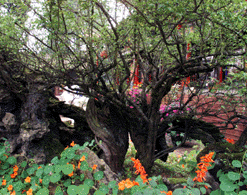
Leaning against a
well-designed rockery in a big flower-covered terrace, the old plum tree is a part of a
huge, graceful bonsai. The bonsai, featuring the rockery, the tree, lichens, some red
flower and round green leaves, can be considered as an independent scenery in itself.
Dating back to the Yuan
Dynasty (1271-1368), the plum tree is one of the country's 11 famous ancient plum trees.
Still blooming in winter, it was named as "Caoxi Imperial Pink" for its pink
flowers by the Chinese Plum Flower Association.
The Main Hall of the
temple is the oldest wooden structure existing in Yunnan Province. One can find a
wood-carved Buddha statue inside the hall. It was an exquisite piece of sculpture.
Here the visitors' eyes
are attracted by a round hole in the crossbeam over the entrance of the hall. It was said
that on night of the Mid-Autumn Festival (the 15th day in the eighth month on the lunar
calendar) in every 60 years, the moon would radiate light into the hall through the hole
and illuminate the Buddha _ moving gradually from his forehead to his abdomen. As a
result, the "Moon Light of Caoxi Temple" has been known as one of the most
mystical scenes in the province.
After a short visit, I
was back to the hot spring area. In a hotel near the hot spring known as the "Number
One under the Heaven," I found a room which is available for a round-the-clock hot
spring shower.
However, since I was not
sure whether the water had actually come from the hot springs, I decided to try the
"Number One hot spring under the heaven."
There is a pond in the
courtyard in front of the two-storey bathhouse. And I found that from the pond's
lichens-covered rock bottom, water was bubbling and emitting steam out of the hot spring ,
which prompted me to make a final decision.
Spending 80 yuan
(US$9.6), I got a single room and a new towel to take a hot spring bath. The room and the
small pool in it was clean and the spring warm. After soaking one hour in the water, I
felt totally relaxed.
Out of the bathhouse,
with my skin feeling smooth and my walk brisk, I felt very good.
On the Tanglang River,
there were two boat-borne restaurants. I chose one named "River-watching
Pavilion" to have my dinner.
At its second floor, I
found a table near the window, through which I could watch the rushing flow in the river.
I ordered a dish of
stir-fried fresh vegetables, a dish of braised rabbit meat with soy sauce, a dish of fried
small fish of the river and several fried tomato cakes for my dinner. They are all fresh
and delicious.
In the next morning, I
got up early, strolled along the southern bank of the river and visited a group of
inscriptions on a four- or five-metre-high cliff stretching along the bank.
A group of about 160
inscriptions, dating back to the Ming (1368-1644) and Qing (1644-1911) dynasties, covered
most of the cliff surface.
In both
calligraphs and paintings, they depicted and eulogized the blessings of Mother Nature to
the area. Watching carefully, I did notice some masterpieces on the cliff.
At that noon, I returned
to Kunming. I felt I was full of energy.
(Photo: Luxuriant plants add
much vitality to the old temple. By Yang Shizhong)
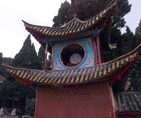
The century-old wood-structured main hall of Caoxi Temple
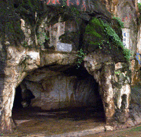
Calligraphy and paintings can be found on the cliff surfaces in Caoxi Temple
