By Chen Liang
KUNMING -- To be a purposeful traveller, one not only
needs time, money and good health, luck is also essential.
Without luck, you may miss a sunrise or
sunset over the sea, or a glimpse of the snow-capped peaks of towering mountains.
And without a huge amount of good luck,
you will definitely not see the wild elephants in Wild Elephant Valley, even if you stay
there for a couple of weeks.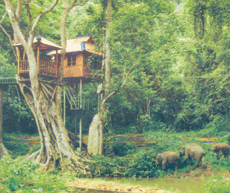
When I headed for the valley in
Xishuangbanna in the deep south of Yunnan Province recently for a two-day trip, luck was
with me in spades.
On the way to the valley, I began to
discuss with Lao Liu, my guide, the possibility of meeting wild elephants inside the
reserve.
Suddenly the driver put on the brakes,
pulled the car over to the side of the winding road, and yelled, "Get out quick, look
at the elephants over there!''
Standing on the other side of the road
looking down over a brook at the bottom of the valley, I saw a group of five wild
elephants breaking out of bamboo clusters in the dense tropical rain forest.
The four adults and a baby walked slowly
by the stream ignoring the cars and people just 20 metres away from them.
After two or three minutes in the
valley, where the sunlight pierced through the canopy of trees, the elephants finally made
their way into the jungle, and disappeared into the trees.
"Luck is on your side,'' Liu
told me when we returned to the car.
"Believe me, it would be
extremely unlikely that the elephants will reappear in this area in the next few weeks.''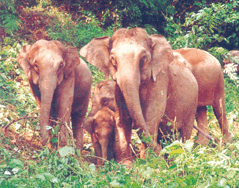
According to the plant taxonomy
researcher, the wild elephants are voracious eaters and therefore have to keep moving to
find food. In the forest reserve of 100,000 hectares, it usually needs one or two months
before a group of elephants appear in the same area twice.
"So don't expect to see
elephants again in Wild Elephant Valley for a while,'' he said. "And the other groups
might be miles away.''
In fact, they were the only elephants I
saw, but the five-minute encounter had satisfied my curiosity.
My exploration of the valley did not
actually start until Lao Liu and I headed for the tree houses at 7:00 pm after our dinner
in the administrative section of the reserve.
Since the cableway connecting the tree
houses -- the main scenic area of the reserve -- with the built-up area (including the
administrative section) stopped operations at 6 pm, we had to walk into the jungle.
According to my guide, the walk would
take about an hour. And we had to hurry up to arrive before darkness fell.
So we hiked into the valley along a
cement path stretching along the stream.
Then I saw the tropical rain forests
veiled by the darkening night -- human-size ferns and sturdy vines wrapped around thick
tree trunks spread across the path, and dense bamboo clusters and huge banyan trees stood
alongside.
I could not tell how many levels the
canopies had. But the trees, like rusted, ivy-choked rockets, looked imposingly tall.
From time to time, I saw some dark
tunnels along the slope with broken bamboos and tree trunks.
Liu told me that most of them were
elephant tunnels. "Occasionally some lonely male elephants will come out of the
tunnels to cross the path to drink in the stream,'' he said.
"They are extremely
dangerous,'' he said.
Once or twice, I ran into spiderwebs
across the path and had to brush them away from my face. Finally, as darkness fell, I
heard the sound of people's voices floating through the dense forests and then saw light
from windows. We had arrived at the tree houses.
The following morning, I was woken by
Lao Liu at 5:00 am. "Let's go to the nitrate pond,'' he said. "Elephants might
come down to drink.''
But they didn't. Except for a shallow
pond and heaps of elephant droppings, there was nothing.
According to Liu, elephants have to
absorb nitrate from time to time. So park workers put nitrate along the stream at times to
attract them.
"It depends on elephants,
though,'' he said.
So in the next two hours, we turned our
attention to the jungle itself. We went back to the walkway stretching across the valley
above the stream and I got a closer look at the forests.
Then I found the canopies were three
levels deep. There were some giant trees hanging with stalactite vines. I looked up,
following the trunk of one of them, and found that the height of the tree alone was
breathtaking.
I also saw some huge "strangler
trees'' with weird roots sprawling along the mountain slope like rolling walls, some trees
with 10-foot roots that fanned out from the trunk like stabilizer fins, and various
beautiful flowers breaking abruptly out of the trunks.
Birds were shuttling back and forth
between the trees, adding a lively touch to the mystical jungle.
(Photos: top: A family of
elephants stroll through the tropical jungle; next to top:Tree houses built in the valley
provide good viewpoints for watching the wild elephants. By Chen Liang)