Bamboo legend
enthrals guests Statues
captivating
By Chen Liang
KUNMING _ A long time ago, an
itinerant monk walked into the rolling Yuan Mountains northwest of the city.
In a valley of lush
forests he planted his bamboo stick in the earth in front of a group of local people, told
them to check the stick again the next day and left.
The following day, the
people found the stick had disappeared to be replaced by a thick growth of bamboo.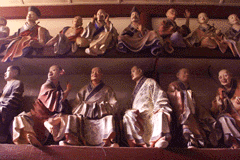
Realizing that the magic
monk had revealed the existence of a holy place to them, they built a Buddhist temple
there in AD 639.
According to legend,
that is how the Bamboo Temple, or Qiongzhu Si in Chinese, 18 kilometres from central
Kunming, got its name.
However, the temple, one
of the most attractive in Yunnan Province, is not known for its bamboo, but for the
stunning religious figures inside _ life-size statues crafted out of clay by Li Guangxiu
in the 1880s.
At that time, the Bamboo
Temple was going through a large-scale renovation after being burnt down and rebuilt in
the 15th century.
The abbot of the temple
employed the master Sichuan sculptor and his five apprentices to fashion 500 (actually
518) luohan (arhats or noble ones). Luohan are Buddhist disciples who have achieved
salvation; they hold an important place in the religion.
After seven years of
hard work, the Bamboo Temple obtained these "pearls of oriental sculpture."
Similar clay religious statues can only be found in a temple near Chengdu, capital of
Sichuan Province.
One drizzly afternoon, I
made a trip to the secluded temple to look at the sculptures.
A religious hush
enveloped the place. I was one of the only 20 visitors to the good-sized temple.
After passing through
the main entrance, I saw two huge fir trees in the courtyard of the Front Hall of the
temple. Soaring high into the sky, the trunks are so thick it needs two or three people
with arms outstretched to encircle them.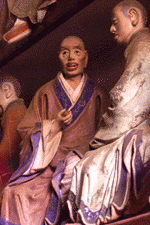
The bulk of the
sculpture collection _ 216 standing figures _ is housed row upon row on tiered shelving,
completely covering the walls of two side rooms in the Front Hall.
The statues _ depicted
in realistic or surreal fashion _ all have different expressions, ranging from happiness
to deep despair.
The variety of poses is
astounding _ a monk caught turning round to emphasize a point in a discussion; a figure
who seems to be talking in whispers with a face veiled in mystery; another has a bizarre
and extremely panicky expression as if scared by a bug creeping under his skin.
The old, the sick, the
emaciated _ they are all there with extremely vivid expressions.
Peering at their faces,
I felt I was gaining some deeper insight into the real world. The figures are reminiscent
of the bubbling and seething activity in a Chengdu teahouse or the Flower and Bird Market
in Kunming.
But the creme de la
creme of the statue collection is hidden inside the Main Hall of the temple. Here 86 of
the most surreal figures are riding on the crests of waves that emerge from the huge walls
in three-dimensional splendour.
The rolling nature of
the waves and the position of the figures resulted in the statues becoming known as the
Surfing Buddhas.
Their faces are
expressive and weird as they ride on a variety of mounts _ blue dogs, giant crabs,
lobsters, turtles, elephants, tigers, unicorns and other traditional mystical beasts.
One of the figures had
eyebrows at least a metre long and another had two faces, a small one being added on the
side of his head. A third was pulling his face open like a mask to reveal another face
inside.
The most eye-catching
statue is a figure with a long arm, which reached out of the mural for a couple of metres
and touched the ceiling of the hall with his fingers.
This so-called
"Long-arm Arhat" was responsible for getting the Buddhist sutra from shelves for
Sakyamuni. With his elastic arm, he could complete the job even when he and the Buddha
were thousands of kilometres away from nirvana.
In legend, master Li
Guangxiu often visited market places and made friends with people of all sorts to make all
his figures look different. And his success is striking.
So lifelike are the
sculptures in the Bamboo Temple that they were considered in bad taste by his
contemporaries. After completing the project, the master disappeared into thin air.
But the temple offers
tourists more than just sculptures.
In the courtyards, I
found many flowers in bloom, such as hydrangeas. There were also several old pear trees
weighed down with fruit.
Visitors lit sticks of
incense in front of the halls, filling the damp air with a heady perfume.
I did not see any bamboo
grove until I stepped into the secluded backyard of the temple. There, groves of dark
green bamboo stood on both sides of a lane covered with lichen.
Walking into the bamboo
forests, I stood for a while and let my thoughts float with the singing of birds back to
the day when the legendary bamboo broke through the soil.
To get to the temple,
rent a taxi for 100 yuan (US$12) for a two-hour trip, or to take a bus in front of the
Yunnan Hotel.
Admission is 10 yuan
(US$1.20) for foreign tourists.
(Photos: top: Statues of
Buddha display many vivid expressions; next to top: A human-size statue represents the
craftsmanship of the ancient sculptors. By Yang Shizhong)
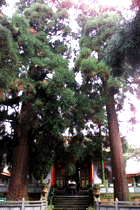
Two ancient trees guard the entrance to the Bamboo
Temple