Climate, variety pep up sector
Tea: the toast of Yunnan
By Jin Hangting and Zhao Shaoqin
KUNMING
_ The alluring fragrance of tea rises from the red earth plateau of Yunnan, lending
another dimension to the colourful province.
Yunnan claims to be the place of origin
of tea plants. According to historical records, cultivation of tea began 2,100 years ago.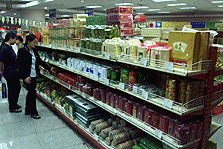
Three ancient tea plants, ranging from
800 to 1,700 years old, now grow in Lincang and Xishuangbanna prefectures in the southwest
of the province. They are known as "the Kings of Ancient Tea Plants" and as
"living fossils" of Yunnan's original tea plants.
Yunnan has a number of attributes making
it an ideal place to develop the tea industry, said Su Yihua, secretary-general of the
Yunnan Provincial Tea Association.
All tea-producing areas in the province
are located at elevations from 1,200 to 2,000 metres, with annual average temperatures
ranging from 12 C to 23 C.
Yunnan's climate is one of the most
suitable in the world for growing tea, Su said. Yunnan tea matures earlier and has a
stronger flavour, he said.
To date, 199 species of tea plant have
been recorded in Yunnan.
Depending on the processing method
involved, Yunnan tea is made into over 100 varieties in the five major categories of
Yunnan black tea, green tea, Pu-erh tea, compressed tea and flower tea, Su said.
Yunnan black tea is drunk all round the
world. It is a popular present as a State gift to foreign VIPs.
Unlike black and green teas, Pu-erh tea
is processed from large-leaf, rough green tea through special fermentation. It was
originally produced in the Tang Dynasty (618-907).
Pu-erh tea and Yunnan Tuocha tea possess
a number of functions beneficial to the health of drinkers, Su said.
Thanks to its geological and climatic
advantages, Yunnan is one of China's leading tea producers.
It currently possesses nearly 290,000
hectares of tea plantations, ranking first in China in terms of area.
Last year, Yunnan produced a record
774,876 tons of tea, third in the country behind Zhejiang and Fujian provinces.
Dozens of tea processing plants are
scattered all over the province.
To further hone the competitiveness of
Yunnan tea, three large tea production and processing groups have been formed in recent
years _ the Yunnan Black Tea Group in Lincang, the Pu-erh Tea Group in Simao and the
Yunnan Tuocha Tea Group in Dali.
Yunnan tea is exported to more than 50
countries and regions. Total exports amounted to 10,337 tons in 1998, earning US$22.58
million in foreign exchange, Su said.
Around 10,000 tons of black tea are sold
mainly to Russia, East Europe and Britain annually, said Chang Jinqiang, manager of the
Yunnan Tea Import and Export Corp's Tuocha tea department.
The company also sells its green tea to
Pakistan, Afghanistan and Germany, Chang said.
Several special kinds of tea, including
Pu-erh and Tuocha, are sold to Taiwan, Hong Kong, Japan, Singapore and France, he said.
Tuocha tea is particularly popular in
France because French people believe it can help eliminate fat, reduce weight, strengthen
the body and lengthen life.
Yunnan's tea exports have a bright
future, Chang said, especially since it is environmentally friendly.
Yunnan has also sought in recent years
to exploit its tea culture.
Southwest Yunnan's Simao Prefecture has
held three international Pu-erh tea festivals to attract visitors.
A large tea culture garden has also been
established in Lincang.
In Kunming, tea houses have flourished
as a place for tourists and locals to relax.
A new tea garden ecological tourism
route was promoted recently. Tourists can take a 145-kilometre bus trip to visit a
130-hectare tea garden in Yuxi's Eshan County.
(Photo: The products dominate the specialty stores in Kunming. By Yang Shizhong)