Colorful costumes grace ethnic group
Lisus reveal beauty of life
By Bian Yi
 THE Lisu ethnic
minority group, comprised of more than 570,000 people,primarily live in concentrated
communities in the Nujiang Lisu Autonomous Prefecture of Yunnan Province. Other members
are scattered THE Lisu ethnic
minority group, comprised of more than 570,000 people,primarily live in concentrated
communities in the Nujiang Lisu Autonomous Prefecture of Yunnan Province. Other members
are scattered
in Lijiang,Diqing, Dali and Chuxiong prefectures or counties of Yunnan and Yanyuan,Yanbian
and Muli counties of Sichuan Province.
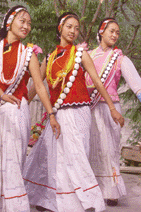
In most areas, the Lisu people wear hemp or cotton clothes. Women
wear short dresses or long skirts, with their heads decorated with red and white glass
beads and their chests with necklaces formed by strings of colourful beads.Men wear short
dresses and pants reaching the knees. Some wear a black turban while a knife hangs at the
left of a man's waist, and an arrow on his right.
The Lisu are divided into three categories,identified by
the colour of their traditionalcostume: the Black Lisu, the White Lisu and the Hua Lisu,
which in Chinese means the colourful Lisu.
Most Black Lisu live along the Nujiang River Valley. Women
of the Black 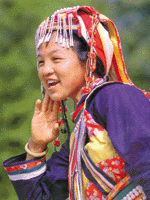 Lisu Lisu
wear hemp or cotton clothes in either all black or black and white. Women of the White
Lisu living in the Fugong area are usually dressed in all white or white with blue, while
the women of the Hua Lisu living in the Dehong area wear skirts made of hundreds of pieces
of cloth of different colours.
The Lisu tradition of dressing has a long history.
According to their legends, the Lisu men often had to leave their homes to fight
their enemies. They often sent their medals and rewards back home
to their women, wrapped in cloth, often of different colours. To show their husbands'
bravery, and to remember their men far away on the frontiers,women sewed the cloths
together and wore them as skirts. They would wear the medals on their clothes, or on their
handkerchiefs.
The Lisu people also pay great attention to their headdress. Women of the Nujiang
Prefecture like to wear hats decorated with beads, white corals and small copper bells.
Environment. The famous Nujiang River Valley is in the territory of Nujiang Lisu
Autonomous Prefecture, where the Lisu people, blocked by high mountains and turbulent
rivers, had hard access to the outside world. For generations, the Lisu people had to meet
difficulties and dangers crossing rivers on simple and crude rattan chain bridges.
Visitors would find themselves crossing range after range of rugged, snow-capped
mountains, the foothills of the mighty Himalayas. The trails seem to hang dangerously
close to the mountain's slippery edge, where one slip will lead to a plunge of thousands
of feet to the valley floor.
(Photo: top: Lisu women dance in their traditional costumes at a festival in Nujiang Lisu
Autonomous Prefecture; next to top: A young Lisu woman displays her colorful costumes. By
Yang Shizhong) |