KUNMING _ A visit to Yunnan is not complete without a trip to a minority area and even more of a missed opportunity without participation in one of the minority festivals.
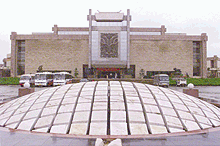
However, for those who do miss out, or for those who want a thorough view of the colourful world of ethnic people, a trip to Yunnan Museum of Nationalities is a good idea.
Located by the beautiful Dianchi Lake, adjacent to Yunnan Ethnic Village, the museum, the largest in the province, occupies an area of 130,000 square metres.
It consists of eight special exhibition areas, covering the development of Yunnan, ethnic dress adornments, folk art, festival and ceremonial music and dance, folk handicrafts, agriculture, ancient books and documents, and gemstones.
The three clans of Qiang, Pu and Yue were the earliest inhabitants of Yunnan. As a result of immigration, division and merging, the distribution of minorities tended to be stable during the Ming and Qing dynasties (1368-1911).
Today Yunnan has a population of 39 million of which more than 10.3 million belong to minorities.
Twenty-six ethnic groups now inhabit Yunnan, preserving their own lifestyles and distinctive culture.
The museum aims to show this diversity through its exhibits of pictures and objects.
The section devoted to festival and ceremonial music and dance is highly recommended.
Traditional ceremonies and festivals are indispensable parts of minority cultures, reflecting different lifestyles and ideological concepts.
It is believed there are at least 300 different dances in Yunnan. They can be categorized in five groups: dancing to drums, songs, strings, lamps, and others.
Carried down from generation to generation, folk dances have been refined, developed and standardized through years of festivals and ceremonies.
The Yi people is now celebrating its Torch Festival.
The Yi, the largest ethnic group in Yunnan, have a population of 3.35 million, living mainly in Chuxiong Prefecture.
The Torch Festival, the Yi's new year, begins on the 24th day of the sixth lunar month (which fell on August 5 this year), as the handle of the Big Dipper turns upwards.
Torches are kindled at night to drive away evil, and people pray for prosperity.
Many activities are held, including wrestling, bullfighting and horse racing.
Other major ethnic festivals include the Sanduo Festival of the Naxi people, the Water-Splashing Festival of the Dai people, the March Fair of the Bai people in Dali, and the Miao Festival of Treading Flower Mountains.
Yunnan is also famous for its colourful textiles and clothes.
From the bark cloth and sheep skin of the olden days up to exquisite modern silk dresses, the dress adornment section reflects the dazzling brilliance of different ethnic cultures.
Dai men usually wear a white jacket and a white cloth turban. Tattoos are common among men. Women prefer colourful bodices with fresh flowers as the most common hair adornment.
Zhuang costumes are usually adorned with colourful embroideries of birds, animals and flowers on headgear, bibs and shoes. Dark blue and black are their favourite colours.
A collarless turtle-shaped coat known as a queba is unique to Hani women. It has semicircular hems and a slit on either side.
When Hani girls reach the age of 10, they begin to wear a small hat with small balls.
Few minorities in Yunnan have their own language. The ancient books and documents section shows how they made records of their lives.
Leaves and fruit could be used to express emotion while rope knots and carved wood could mean a promise.
In Jinpo, if a man presents a chicken feather tied on a wood board with three knife cuts, he is suggesting eloping in three days.
In Bulang, ormosia leaves express love as high as a mountain, while a pepper leaf means "I don't want to see you any more."
The folk art section is also a must on your itinerary.
Yunnan's folk arts are impressive. They not only have strong historical and religious connotations, but reflect regional characteristics and ethnic artistic features.
(Photo: top: Yunnan Museum of Nationalities;
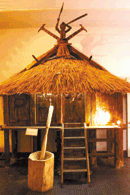
next to top: A traditional dwelling of the Va people showcased in the Yunnan Museum of Nationalities. Photos by Yang Shizhong)

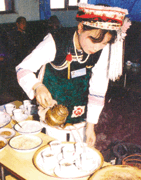
Bai people worshipping white
By Song Ping THE Bai minority , with a population of 1,590,000, have lived on the foot of the Cangshan Mountains by Erhai Lake for more than 4,000 years.
The majority of the Bai people reside in Dali Bai Autonomous Prefecture in Southwest China's Yunnan Province.
The Bai people's reverence for the colour white is evident. The men typically wear a white coat with a black sleeveless jacket and deep-coloured trousers while most women are dressed in white blouses with red sleeveless jackets and blue trousers.
The Bai people are good at singing and dancing, especially during weddings, hunting, house buildings and harvests.
The music and dance of the Bai exemplify their distinctive style. Popular ballad tunes include "Tage Tune," "Niqiu Tune," "Xishan Tune," and "Daben Tune." Traditional dance repertoires include "Lion Dance," "Dance with King's Whip," and "Dance of Swallow in Pair."
Warm and hospitable, the Bai people welcome their guests in a special way _ three courses of tea. The first course is bitter; the second is sweet and the third has a strong aftertaste.
The Bai people have many traditional holidays, such as the "March Fair," "Butterfly-collecting Festival," and "Flower Festival."
With a history of more than 1,000 years, the "March Fair" is a grand festival usually held between March 15 and 22. Today, following the rapid development of the local economy, the fair has evolved into a trade fair and an occasion for various recreational events.
Traditional Bai architecture is very characteristic. The classic Bai mansion consists of a compound and a quadrangle with four houses around a big courtyard, with small courtyards at each of its four corners. The screen walls and the arch over the gateway are especially elaborate.